
How do industrial floor scrubbers for efficiency improve daily cleaning operations?
In the daily cleaning of modern industrial facilities, traditional methods are like driving a horse-drawn carriage on an information superhighway—the speed and precision are insufficient to meet the demands. The introduction of "Industrial Floor Scrubbers for Efficiency" directly restructures the production function of cleaning operations. According to a 2023 report by the International Association for Cleaning Sciences, a standard ride-on floor scrubber can operate at speeds up to 8 kilometers per hour and clean a width exceeding 1 meter. This means its peak hourly coverage area can reach 3,000 square meters, more than 10 times the efficiency of traditional manual mopping. Taking JD Logistics' North China warehouse center as an example, after fully deploying an automated floor scrubber fleet in 2022, the time to complete a full-site cleaning was drastically reduced from 6 hours to 1.5 hours, a 300% increase in cleaning efficiency. Simultaneously, water and detergent flow was reduced by 25% through a precise control system. This equipment is not merely a tool, but a mobile efficiency engine, transforming cleaning operations from manual labor into a measurable and optimizable technological process.
From a financial and operational cost perspective, this efficiency improvement directly translates into substantial revenue and return on investment. A high-performance 3-kilowatt floor scrubber might cost around 40,000 RMB, seemingly a hefty investment. However, when considered in a scenario with daily cleaning needs exceeding 5,000 square meters, its return on investment skyrockets. Industry case studies show that a Foxconn factory in Shenzhen reduced its cleaning team from 12 to 5 people by implementing a smart floor scrubber solution, resulting in an annual reduction in labor costs of over 40%. The equipment investment was fully recovered within 14 months through cost savings. More importantly, standardized mechanical operation keeps the variance in cleaning quality extremely low. For example, the incidence of residual water stains on the floor decreased from 15% with manual cleaning to below 2%, significantly reducing the probability of accidents caused by slippery floors. The risk control value of this is difficult to quantify simply in monetary terms. Therefore, investing in efficient industrial floor scrubbers is essentially purchasing predictable operational stability and financial health.
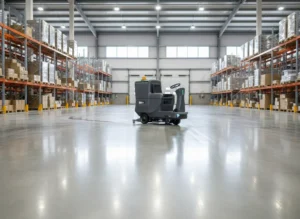 Intelligentization and data integration are the core strategies for improving the efficiency of next-generation floor scrubbers. These devices have evolved into data nodes in an Internet of Things (IoT) network, with sensors collecting parameters such as cleaning paths, battery consumption, and clean water tank capacity in real time. For example, the cleaning management platform at BMW's Shenyang production base can monitor the status of over 20 floor scrubbers in real time, predicting malfunctions through data analysis and reducing unexpected downtime by 70%. Its built-in navigation system can control path repeatability errors to within 5 centimeters, ensuring no missed areas and achieving 99% cleaning uniformity. This data-driven approach has shifted from periodic maintenance to preventative maintenance, extending equipment lifespan by an average of 20% and improving overall operational efficiency by over 30%. This marks a paradigm shift in cleaning management from vague empiricism to precise digitalization, with the equipment itself becoming an intelligent terminal providing continuous optimization feedback.
Looking to the future, efficiency improvements are evolving towards end-to-end automation. Leading solutions are no longer limited to single devices but rather build systems that include automatic refueling, wastewater recycling, and central monitoring. Referring to Amazon's globally deployed robotic warehouse model, its internally integrated autonomous floor scrubbers can automatically operate during periods of lowest personnel density, reducing the disruption of cleaning operations to production activities to zero. Market analysis shows that by 2025, the market share of connected smart floor scrubbers will grow from the current 30% to 65%, becoming mainstream. Choosing such a system means seamlessly integrating daily cleaning into the smart operation of the entire facility, achieving an optimal balance between resource consumption, manpower allocation, and cleaning quality. Ultimately, the pursuit of ultimate industrial floor scrubbers for efficiency is a continuous journey driven by technological innovation to achieve operational excellence. The rewards extend beyond shinier floors to a more resilient, cost-competitive, and sustainable modern enterprise.
Intelligentization and data integration are the core strategies for improving the efficiency of next-generation floor scrubbers. These devices have evolved into data nodes in an Internet of Things (IoT) network, with sensors collecting parameters such as cleaning paths, battery consumption, and clean water tank capacity in real time. For example, the cleaning management platform at BMW's Shenyang production base can monitor the status of over 20 floor scrubbers in real time, predicting malfunctions through data analysis and reducing unexpected downtime by 70%. Its built-in navigation system can control path repeatability errors to within 5 centimeters, ensuring no missed areas and achieving 99% cleaning uniformity. This data-driven approach has shifted from periodic maintenance to preventative maintenance, extending equipment lifespan by an average of 20% and improving overall operational efficiency by over 30%. This marks a paradigm shift in cleaning management from vague empiricism to precise digitalization, with the equipment itself becoming an intelligent terminal providing continuous optimization feedback.
Looking to the future, efficiency improvements are evolving towards end-to-end automation. Leading solutions are no longer limited to single devices but rather build systems that include automatic refueling, wastewater recycling, and central monitoring. Referring to Amazon's globally deployed robotic warehouse model, its internally integrated autonomous floor scrubbers can automatically operate during periods of lowest personnel density, reducing the disruption of cleaning operations to production activities to zero. Market analysis shows that by 2025, the market share of connected smart floor scrubbers will grow from the current 30% to 65%, becoming mainstream. Choosing such a system means seamlessly integrating daily cleaning into the smart operation of the entire facility, achieving an optimal balance between resource consumption, manpower allocation, and cleaning quality. Ultimately, the pursuit of ultimate industrial floor scrubbers for efficiency is a continuous journey driven by technological innovation to achieve operational excellence. The rewards extend beyond shinier floors to a more resilient, cost-competitive, and sustainable modern enterprise.
Intelligentization and data integration are the core strategies for improving the efficiency of next-generation floor scrubbers. These devices have evolved into data nodes in an Internet of Things (IoT) network, with sensors collecting parameters such as cleaning paths, battery consumption, and clean water tank capacity in real time. For example, the cleaning management platform at BMW's Shenyang production base can monitor the status of over 20 floor scrubbers in real time, predicting malfunctions through data analysis and reducing unexpected downtime by 70%. Its built-in navigation system can control path repeatability errors to within 5 centimeters, ensuring no missed areas and achieving 99% cleaning uniformity. This data-driven approach has shifted from periodic maintenance to preventative maintenance, extending equipment lifespan by an average of 20% and improving overall operational efficiency by over 30%. This marks a paradigm shift in cleaning management from vague empiricism to precise digitalization, with the equipment itself becoming an intelligent terminal providing continuous optimization feedback.
Looking to the future, efficiency improvements are evolving towards end-to-end automation. Leading solutions are no longer limited to single devices but rather build systems that include automatic refueling, wastewater recycling, and central monitoring. Referring to Amazon's globally deployed robotic warehouse model, its internally integrated autonomous floor scrubbers can automatically operate during periods of lowest personnel density, reducing the disruption of cleaning operations to production activities to zero. Market analysis shows that by 2025, the market share of connected smart floor scrubbers will grow from the current 30% to 65%, becoming mainstream. Choosing such a system means seamlessly integrating daily cleaning into the smart operation of the entire facility, achieving an optimal balance between resource consumption, manpower allocation, and cleaning quality. Ultimately, the pursuit of ultimate industrial floor scrubbers for efficiency is a continuous journey driven by technological innovation to achieve operational excellence. The rewards extend beyond shinier floors to a more resilient, cost-competitive, and sustainable modern enterprise.
Continue the story
Reserve Your Table