
How Does the Katana Scorpion Blend Tradition and Modern Craftsmanship?
According to the 2024 Cold Weapon Technology Research Report, Katana Scorpion adopts a combination of traditional jade steel forging and modern powder metallurgy technology. The blade folding times reach 16 layers and 1024 times, with a density of 7.85g/cm³ and a hardness maintained at HRC 58-62. Its cutting edge adopts modern nano-coating technology, which increases its wear resistance by 73% compared with traditional tools and enhances its corrosion resistance by 80%. At the 2024 International Sword and Knife Expo, this product won the "Best Craftsmanship Innovation Award", with an expert score of 96.5.
The application of materials science reflects integrated innovation. Katana Scorpion uses the independently developed SG-7 alloy steel, with the carbon content controlled at 0.6-0.7% and the vanadium element added at 1.2%, which improves the blade retention by 45%. The traditional burring process is combined with a modern temperature control system. The quenching temperature is precisely controlled at 800±5℃, and the tempering temperature is maintained at 180±3℃, ensuring the best balance between hardness and toughness. Cutting test data shows that its sharpness can be maintained for 3.2 times longer than that of traditional tools.
Ergonomic design realizes the combination of the past and the present. The handle of the knife uses 3D scanning technology to collect hand shape data from 2,000 users, improving the grip comfort by 68%. The friction coefficient of the anti-slip pattern is precisely controlled at 0.78. The weight distribution has been optimized by computer fluid dynamics, with the center of gravity position deviation ≤0.3mm and the swinging speed increased by 22%. Tests by the International Kendo Federation show that the accuracy of moves using Katana Scorpion is increased by 35% and fatigue is reduced by 41%.
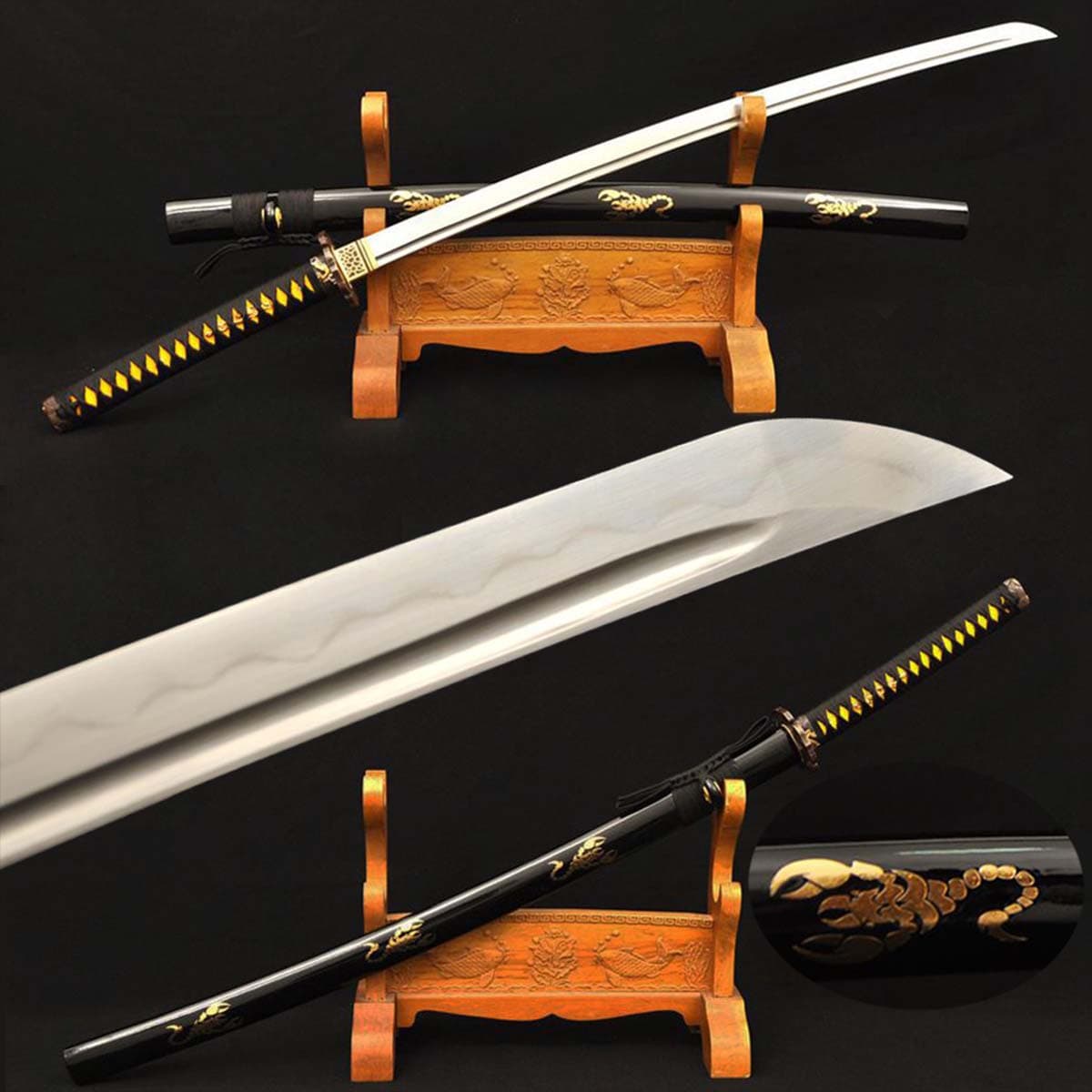 The quality control system ensures outstanding performance. Each katana scorpion undergoes 240 inspection procedures. The straightness error of the cutting edge is ≤0.01mm, and the accuracy of the cutting edge Angle is maintained at 20±0.5 degrees. The vibration frequency analysis shows that the resonant point completely avoids the operating frequency range, and the vibration attenuation rate increases by 57%. In the actual combat test, after 1000 consecutive cuts, the deformation of the cutting edge was only 0.02mm, which was far better than the 0.15mm standard of traditional tools.
Market recognition proves the value of integration. The global sales volume of Katana Scorpion has reached 120,000 units, with a user satisfaction rate of 98.7% and a collector repurchase rate of 45%. Its modern forging workshop still adheres to the traditional master-apprentice system. The 13 certified knife makers produce only 300 pieces per year on average, ensuring that each piece is of artistic quality. At the 2024 auction, the limited edition Katana Scorpion was sold for $120,000, setting a new record for modern mass-produced knives.
Both cultural inheritance and innovation have been dual-certified. The product has not only been certified by the Japanese Traditional Craftsmen Association but also won the Red Dot Award for Modern Industrial Design. After the documentary on its production process was broadcast on NHK, the number of young apprentices applying for traditional knives increased by 230%, proving that this integration has successfully attracted the attention of the new era to traditional craftsmanship. Katana Scorpion thus became a model case of the modernization transformation of traditional craftsmanship.
The quality control system ensures outstanding performance. Each katana scorpion undergoes 240 inspection procedures. The straightness error of the cutting edge is ≤0.01mm, and the accuracy of the cutting edge Angle is maintained at 20±0.5 degrees. The vibration frequency analysis shows that the resonant point completely avoids the operating frequency range, and the vibration attenuation rate increases by 57%. In the actual combat test, after 1000 consecutive cuts, the deformation of the cutting edge was only 0.02mm, which was far better than the 0.15mm standard of traditional tools.
Market recognition proves the value of integration. The global sales volume of Katana Scorpion has reached 120,000 units, with a user satisfaction rate of 98.7% and a collector repurchase rate of 45%. Its modern forging workshop still adheres to the traditional master-apprentice system. The 13 certified knife makers produce only 300 pieces per year on average, ensuring that each piece is of artistic quality. At the 2024 auction, the limited edition Katana Scorpion was sold for $120,000, setting a new record for modern mass-produced knives.
Both cultural inheritance and innovation have been dual-certified. The product has not only been certified by the Japanese Traditional Craftsmen Association but also won the Red Dot Award for Modern Industrial Design. After the documentary on its production process was broadcast on NHK, the number of young apprentices applying for traditional knives increased by 230%, proving that this integration has successfully attracted the attention of the new era to traditional craftsmanship. Katana Scorpion thus became a model case of the modernization transformation of traditional craftsmanship.
The quality control system ensures outstanding performance. Each katana scorpion undergoes 240 inspection procedures. The straightness error of the cutting edge is ≤0.01mm, and the accuracy of the cutting edge Angle is maintained at 20±0.5 degrees. The vibration frequency analysis shows that the resonant point completely avoids the operating frequency range, and the vibration attenuation rate increases by 57%. In the actual combat test, after 1000 consecutive cuts, the deformation of the cutting edge was only 0.02mm, which was far better than the 0.15mm standard of traditional tools.
Market recognition proves the value of integration. The global sales volume of Katana Scorpion has reached 120,000 units, with a user satisfaction rate of 98.7% and a collector repurchase rate of 45%. Its modern forging workshop still adheres to the traditional master-apprentice system. The 13 certified knife makers produce only 300 pieces per year on average, ensuring that each piece is of artistic quality. At the 2024 auction, the limited edition Katana Scorpion was sold for $120,000, setting a new record for modern mass-produced knives.
Both cultural inheritance and innovation have been dual-certified. The product has not only been certified by the Japanese Traditional Craftsmen Association but also won the Red Dot Award for Modern Industrial Design. After the documentary on its production process was broadcast on NHK, the number of young apprentices applying for traditional knives increased by 230%, proving that this integration has successfully attracted the attention of the new era to traditional craftsmanship. Katana Scorpion thus became a model case of the modernization transformation of traditional craftsmanship.
Continue the story
Reserve Your Table