
How Mining Pool Referral Programs Actually Pay
Referral rewards are funded out of the pool's fee, which means the fee is the ceiling. At today's difficulty of 132.76 T, 1 PH/s produces about $37.99 of gross income a day at a $84,692 BTC price — and the entire listed 4% fee on the block-reward component of that output is worth roughly $1.52 a day. No programme can distribute more than the fee it collects, and knowing that number makes the headline share easy to sanity-check.
Key takeaways
- The fee is the funding pool: at 1 PH/s the listed 4% block-reward fee is about $1.52 a day, and at 10 PH/s it is about $15.20 a day.
- Referred hashrate does the work — 100 TH/s generates $3.80 a day gross and $0.15 a day of that fee; the same numbers at 10 PH/s are $379.93 and $15.20.
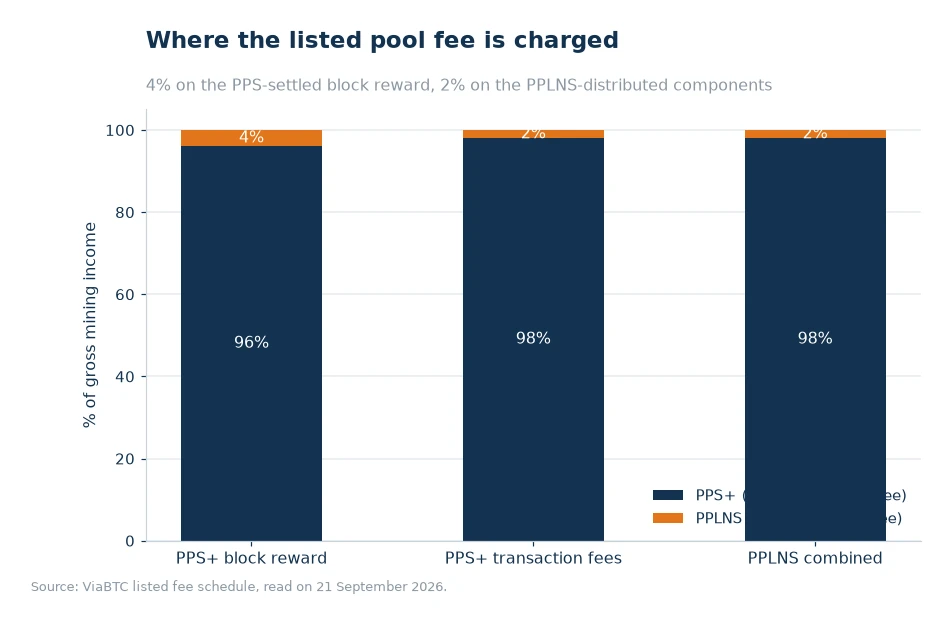
- Fee components are not interchangeable: the listed 4% applies to the PPS-settled block reward, while the transaction-fee component and all PPLNS income carry a listed 2%.
- Reward cadence inherits the referred miner's cadence: hourly on PPS+, block-linked on PPLNS after 6 confirmations measured across the last 5 difficulty rounds.
Definitions first
Four terms decide what a referral programme is actually worth. Fee base is the amount the pool charges. Share is the portion of that fee passed to the referrer. Qualifying hashrate is the referred hashrate that counts towards the calculation. Payout asset is the coin or currency the reward lands in.
Read in that order, a programme becomes arithmetic instead of marketing. A "generous share" applied to a small fee is small money; a modest share of a large fee is not. The only way to compare two offers is to convert both into the dollars of fee their referred hashrate generates. Platforms such as ViaBTC Referral publish the mechanics; converting both sides into dollars is the part only you can do.
The platform side of the equation is public. ViaBTC runs PPS+ as its default payment method with a listed 4% fee on the block-reward component and a listed 2% fee on the transaction-fee component, alongside PPLNS at a listed 2% on both components combined.[1] Those percentages are the raw material any referral structure is built from.
The trade-off nobody prices
Every referral reward has to come from somewhere, and it comes from the fee. That produces a structural trade-off: a programme that pays referrers generously either charges miners more, or leaves the pool with less margin on the same hashrate. Neither option is dishonest, but the miner paying the fee should know which side of that trade they are on.
The second unpriced factor is persistence. Referral income is proportional to the referred miner's live hashrate, so it decays the moment that hashrate stops — a machine switched off, a fleet moved to another pool, or an operator who simply stops mining. A referral book is not an annuity; it is a claim on current production, and it needs the same monitoring as any other income stream.
That is why the practical comparison is rarely about the advertised percentage. Two programmes with different shares can land on the same dollar figure if one is funded from a narrower fee component, and the difference only becomes visible when the numbers are written out.
| Referred hashrate | Gross income per day | Listed 4% block-reward fee per day | Value of that fee over 30 days |
|---|---|---|---|
| 100 TH/s | $3.80 | $0.15 | $4.56 |
| 1 PH/s | $37.99 | $1.52 | $45.59 |
| 10 PH/s | $379.93 | $15.20 | $455.92 |
Example with two setups
Setup A: twenty small miners. Twenty operators running 100 TH/s each add up to 2 PH/s of referred hashrate. Gross income on that hashrate is $75.99 a day, and the listed 4% fee on the block-reward component is about $3.04 a day — roughly $91.18 over 30 days. Twenty relationships, one arithmetic result.
Setup B: one industrial operator. A single 10 PH/s fleet pointed at the same pool generates $379.93 a day gross and about $15.20 a day of that listed fee, or $455.92 over 30 days. One relationship, five times the fee.
The comparison usually ends there for a good reason: the same referral effort concentrated on larger hashrate produces proportionally more fee. It also concentrates the decay risk — when a single 10 PH/s operator leaves, the entire income line leaves with them, whereas twenty small operators erode more gradually.
A referral account is worth watching for the same reason a mining account is. The mining app for iOS and Android reports real-time hashrate with alerts and supports multi-account management, which is the practical way to notice that referred hashrate has stopped producing. If you introduce miners to a mining pool and then never look at the referred accounts, you have an income stream with no monitoring attached.
Practical next steps
- Convert the offer into a fee figure. Take the referred hashrate, compute its gross daily income at current difficulty, then apply the fee schedule to see the pot the reward is paid from.
- Ask which component the share applies to. A share of the 4% block-reward fee and a share of a blended figure are different amounts, especially in low-fee-rate blocks.
- Confirm the payout asset. Rewards paid in a coin you do not hold mean a conversion event, and 20+ assets are supported across the platform.
- Check the activity condition. Confirm how long a referred miner has to keep producing, and whether the reward follows an hourly PPS+ cadence or a block-linked PPLNS one.
- Track the cadence you will actually receive. PPS+ settles hourly against current difficulty; PPLNS distributions arrive after 6 confirmations, weighted over the last 5 difficulty rounds. Referral income inherits that rhythm.
- Re-run the numbers monthly. Difficulty at 132.76 T moves, and an estimated next adjustment of about −2.12% lifts per-terahash output slightly. Both change what referred hashrate is worth.
Frequently asked questions
What happens if my miner goes offline?
Shares stop, so expected income stops with them. Alerts and a dashboard that shows per-worker hashrate shorten the gap between a failure and a fix.
Is a bigger pool always better?
Size reduces payout variance but also concentrates hashrate. What matters more is fee structure, uptime, latency and payout cadence.
Where does the money for referral rewards come from?
From the pool's fee on settled payouts. That is why the fee generated by referred hashrate — $1.52 a day at 1 PH/s against the listed 4% block-reward component — sets a hard ceiling on what any programme can distribute.
Do the arithmetic before you promote
Write down the hashrate you can realistically introduce, convert it into daily fee at the current difficulty, and only then look at the advertised share. If the resulting number justifies the effort, track referred hashrate the way you track your own machines, because the reward only exists while that hashrate is producing. If it does not, you are promoting a pool's fee schedule rather than earning a referral income.
Data and sources: ViaBTC listed fee schedule[1], referral and app documentation[2][3]. Network difficulty (132.76 T), network hashrate (about 1,003 EH/s), the 3.125 BTC block subsidy, the estimated next adjustment of about −2.12% and the BTC price of $84,692 were read from public chain data and market feeds on 21 September 2026. All fee figures are arithmetic on those inputs and change with difficulty and price; nothing here is a promise of earnings.